

Why Cohort Targeting is the Future of Pharma Sales
For decades, pharmaceutical sales strategies have heavily relied on a one-by-one approach. Reps are handed a list of top-decile prescribers and told to knock on their doors individually. However, this fragmented approach ignores a fundamental truth about the medical field: healthcare professionals do not operate in a vacuum; but rather in HCP cohorts.
Treating doctors as isolated targets leaves massive opportunities on the table, especially in today’s saturated market. In a single year, an average doctor receives around 2,800 contacts from pharmaceutical companies. Facing this overwhelming volume of outreach, up to 85% to 90% of medical offices now operate as “no-see” clinics, severely restricting or completely blocking traditional sales representatives. To break through this wall, sales teams must move beyond engaging single HCPs and start identifying cohorts and connected networks.
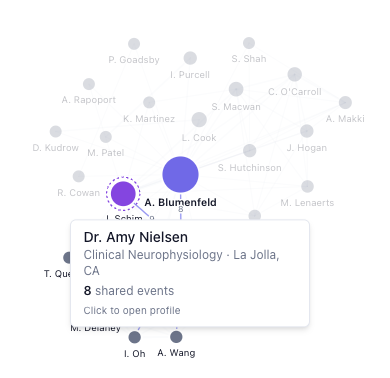
The Power of Hidden Connections
Untapped relationships exist all throughout the HCP cohort population. These connections take many forms: doctors who attended the same medical school, specialists who frequently co-author research papers, professionals who attend the same sponsored dinner programs, or local referral networks where primary care physicians feed patients to specific surgeons.
Having an inside track on these relationships allows reps to map out distinct spheres of influence. For example, if a rep knows that a target doctor highly respects a specific peer, mentioning that peer’s positive experience with a product can instantly build momentum. Furthermore, identifying “bridge” figures (prescribers who connect different institutional cliques or regional communities), allows reps to amplify their message far beyond a single clinic.
The Effort Barrier: Why We Ignore the Goldmine
If these cohorts are so valuable, why aren’t more reps targeting them? The answer comes down to friction and effort. Sales representatives spend up to 50% of their working hours just traveling between locations. With such limited time, manually hunting down these HCP connections, cross-referencing LinkedIn profiles, reading through old publication co-authors, and performing “spreadsheet kung-fu” on available data is an incredibly arduous process.
Consider an everyday example: You would probably never manually log into your bank’s website, navigate through the menus, and check your exact balance every single morning. The process is just annoying enough that the daily payoff doesn’t seem worth the effort. But what if your banking app sends you an automated push notification with your balance each morning? Suddenly, you are catching fraudulent charges early and staying perfectly on top of your finances. The value is the exact same. It just needed to be completely free of effort for you to actually use it.
Because mapping clinical networks manually is too difficult, reps revert to generic pitches. As a result, only 16% of pharmaceutical sales reps consistently engage HCPs with highly relevant messaging, while the other 84% struggle to stand out.
Turning HCP Cohort Data into Action
This is where automation and AI fundamentally change the game. Modern AI platforms like FlyMedical can ingest massive amounts of data (e.g. CMS records, OpenPayments, institutional affiliations, publication histories) to perform similarity analysis and identify “lookalike” HCPs and interconnected cohorts.
By automating the heavy lifting, reps are handed the “push notification” of sales intelligence. When reps use these automated insights to deliver hyper-relevant, contextualized messaging, the results are staggering.
Industry data shows that 88% of HCPs are twice as likely to meet with a rep if the interaction mirrors their best, most consultative relationships. Furthermore, a positive, highly relevant interaction makes 35% of HCPs more likely to meet with others from that same company, and 41% more likely to open their emails and listen to their messages.
Sales teams using AI-driven coaching and targeting see a 50% increase in productivity and a 40% improvement in closing rates. By letting technology do the tedious work of finding the hidden connections, field teams can stop operating as isolated message-deliverers and start acting as highly strategic consultants who understand the exact social and professional fabric of their territory.
We shouldn’t expect every rep to master spreadsheet kung fu just to talk to an HCP. But by leverage insight on HCP cohorts, they’re better positioned than zero.